

From experimental curiosity to practical platform
Nanopores have emerged as powerful tools for single-molecule sensing, enabling detection and analysis of DNA, proteins, and small biomolecules with unprecedented sensitivity.
As opposed to biological nanopores, solid-state nanopores offer advantages in scalability, stability, and compatibility with semiconductor manufacturing, paving the way for mass‑producible sensing platforms for proteomics and molecular diagnostics.
Current research on solid-state and hybrid nanopores is largely limited to specialized lab setups that are manual, complex, and low-throughput, making real-world applications difficult.
Imec addresses this gap by developing a fully integrated system around solid-state nanopores. Combining wafer-scale nanopore fabrication with mass-manufacturable fluidics, scalable electrical readout, and advanced data analysis software, imec’s platform allows life science companies and assay developers to deploy single-molecule sensing at scale.
This transforms nanopores from experimental curiosities into a practical and cost-effective system demonstrator to develop application-relevant chemistries for proteomics and beyond.
From fluidics to advanced data analysis – building blocks de-risked and ready
Each component of imec’s nanopore platform acts like a Lego block. De-risked individually, these building blocks fit together seamlessly to form an integrated minimum viable system, designed to scale towards a high-throughput system. Let’s take a closer look at the building blocks and their status today.
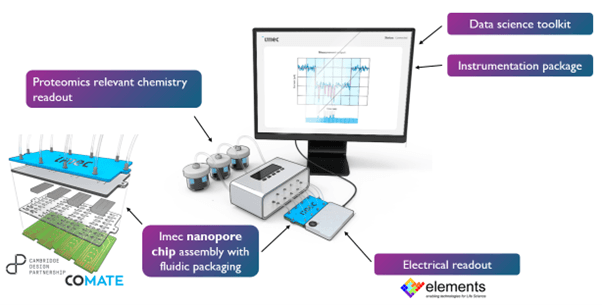
Overview of imec’s nanopore reader minimal viable system with the building blocks being de-risked at this stage.
The nanopore cartridge comprises – from bottom to top – an electrode interconnect layer, a bottom fluidic layer, a solid-state nanopore layer, a top fluidic layer, and a fluidic packaging interface layer. It is developed together with Cambridge Design Partnership.
The unique fluidics approach with on-chip valving and sample distribution allows individual sample delivery to each nanopore. Today, it is tested with 4-nanopore chips, and this will be extended in the future to 96-nanopore arrayed chips, each individually addressable.
Today, our minimum viable system is targeting a density larger than one nanopore per mm² while keeping further density scaling in mind.
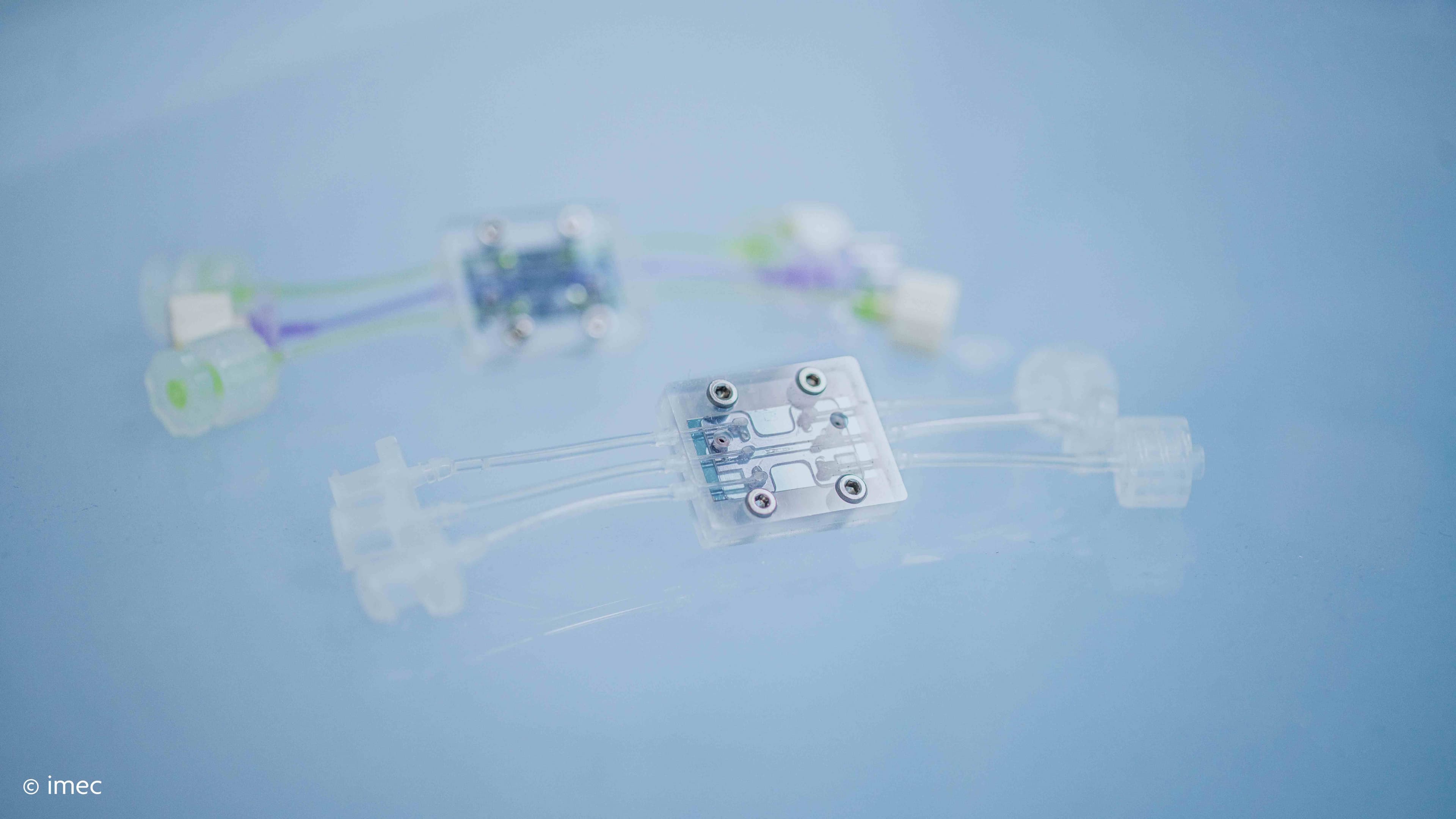
To further facilitate early feasibility testing of assays on single nanopores, we have also packaged single-nanopore devices to bridge the gap towards chemistry developers unfamiliar with solid-state nanopore technology, all in collaboration with our partner, Comate.
The electrical readout is developed in partnership with Elements SRL. It supports 128 channels and 10 MHz bandwidth, with ultra-low-noise current sensing. Moreover, it is a scalable architecture to support additional channels in the future This is coupled with an imec-developed data acquisition framework to support high data rates.
The instrumentation package comprises a scalable single-molecule readout platform that enables real-time event classification and recognition using machine-learning algorithms. It can scale up to 1,000 channels with a 10 MHz bandwidth. Real-time execution is enabled by parallelized execution supporting pre-trained machine learning models.
The cloud-based data science toolkit is specifically developed to handle large amounts of data, connecting information about each fabricated chip, the properties of its nanopores, and the individual molecules passing through them.
It allows researchers to analyze patterns across many single-molecule events and even train AI models to recognize trends or make predictions. In the process of validating its EUV nanopores, imec measured over 4,000 individual nanopores, the largest statistical study ever conducted.
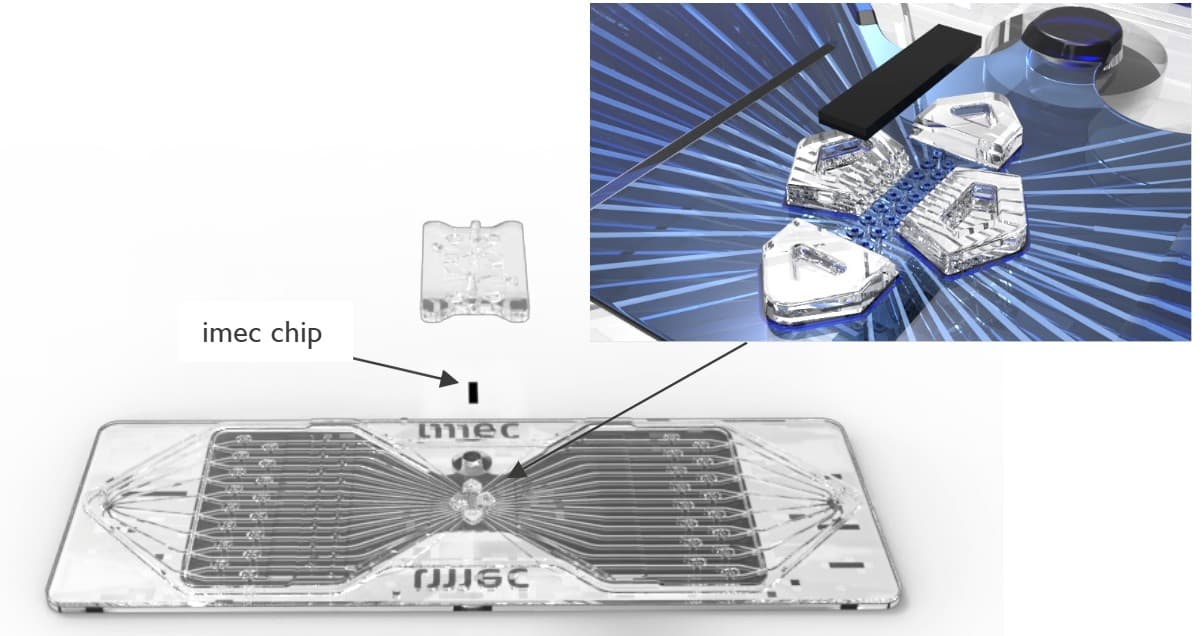
Ensuring individual addressability of a solid state nanopore array in a cheap and manufacturable package (prototype render)
Conclusion
With a process to produce wafer-scale solid-state nanopores and a fully integrated system now taking shape, imec is turning single-molecule sensing into a practical, mass-manufacturable technology.
By de-risking each building block – from nanopore chips and fluidics to scalable readout and data intelligence – the platform moves beyond bespoke lab setups toward a robust solution that can support real-world assays at scale.
In the coming months, imec will publish several research papers on the validation of the system’s building blocks.
In the near future, life science companies and assay developers will be able to access this platform to develop, test, and refine their own single-molecule assays, accelerating innovation in sensing, diagnostics, and molecular analysis.
Interested in developing or testing your single-molecule assay on imec’s nanopore platform? Contact us at health@imec.be to explore collaboration opportunities.
Want more technical reading?
At the 2026 IEEE International Solid-State Circuits Conference (ISSCC), the paper “A 256-Channel Event-Driven Readout for Solid-State Nanopore Single-Molecule Sensing with 193 pArms Noise in a 1 MHz Bandwidth” has been presented, showcasing a proof-of-concept ASIC readout developed by imec, to support next-generation custom nanopores.