
Flanders at the forefront of drug discovery and development
Flanders has long been a global hub for life sciences. Home to giants like Janssen Pharmaceutica and UCB, and supported by a dense network of hospitals, biotech startups, contract research organizations, and academic centers, the region has built a reputation for excellence in the whole drug pipeline and clinical research. Strategic investments in research powerhouses like VIB and clusters like Flanders.bio have supported this fertile ground for innovation.
This scientific expertise is supported by the region’s regulatory agility. Belgium consistently ranks among Europe’s fastest environments for clinical trial approvals. Under the EU Clinical Trials Regulation, processes have been streamlined to deliver some of the shortest timelines on the continent - as little as 15 days for Phase I trials, compared to the EU standard of 50 days (as per official guidance of the CT-College and FAMHP). In a field where time-to-market can determine success or failure, this regulatory efficiency makes Flanders an attractive launchpad for innovative therapies.
Yet, finding new drugs has never been more difficult. Around 90% of drug candidates fail, development costs exceed € 2 billion per drug, and timelines stretch over a decade (according to estimates from the FDA). Biological complexity, stricter safety regulations, and the limits of current preclinical models make the process slow, expensive, and unpredictable.
Why AI isn’t enough
AI is expected to change that, but so far, it hasn’t delivered the magic bullet. Computational approaches to drug design already date back to the 1970s and 80s with physics-based simulations or machine-learning approaches. A breakthrough came in the mid-2010s with AI models like AlphaFold, which revolutionized protein structure prediction. But translating these insights into safe, effective drugs remains difficult, partly due to limited available computational power.
The vision for in silico drug design is nevertheless compelling: genomic and clinical data can guide the selection of disease targets, helping researchers pinpoint the molecular mechanisms behind a condition. Physics simulation models, generative AI or hybrid techniques can then propose candidate molecules or optimize existing compounds, simulating or predicting how they might interact with those targets.
In theory, this could dramatically shorten timelines and reduce costs. But these predictions require massive, high-quality datasets as input and still struggle to capture the full complexity of human biology. Without experimental systems that can validate results quickly and at scale, the promise of AI remains out of reach. The bottlenecks persist: data quality, biological fidelity, and computational power.
Moreover, Europe’s biotech sector faces critical bottlenecks due to fragmented workflows and reliance on global supply chains. The upcoming EU Biotech Act aims to address these challenges by fostering strategic autonomy and accelerate the time to market by aligning AI infrastructure, data creation, and technology platforms on European grounds.
The future of drug discovery thus won’t be written by algorithms alone. It requires deep-tech integration – combining advanced biology with cutting-edge hardware and AI infrastructure. And that’s where Flanders again has a unique advantage.
Bridging chips and cells
Imec, headquartered in Leuven, is a global research leader in nanoelectronics and digital technologies, pioneering chip architectures, sensor platforms, and advanced computing systems that power everything from smartphones to AI supercomputers.
Imec’s strength lies in integrating hardware and software innovation. By leveraging its expertise in chip design, computer architecture and high-throughput data generation, imec develops specialized hardware and novel algorithms to solve the ecosystem's compute bottlenecks.
But raw compute often isn't enough. A deep understanding of computational modelling and its data limitations is crucial to correctly predict and simulate intricate systems, such as biology. Hybrid approaches are therefore being developed to find the sweet spot between the precision of physics-based simulations with the speed and scalability of machine learning. This combination can make complex modelling faster, more efficient, and broadly accessible - democratizing access to powerful tools for organizations of all sizes.
In addition to these advances, genomics and synthetic biology have become foundational to modern drug discovery and development, especially for manufacturing small quantities of novel compounds during early-stage research. Advances in genomics – such as high-throughput DNA sequencing and synthesis – enable researchers to decode disease mechanisms, identify therapeutic targets, and design tailored molecules with unprecedented precision. Synthetic biology, meanwhile, provides the tools to engineer and test these molecules, accelerating the design-build-test cycle and enabling rapid prototyping of new drugs.
Imec’s integrated approach is transforming healthcare by combining advanced hardware and intelligent software. On the hardware front, imec develops high throughput DNA sequencing and DNA synthesis chips, as well as electroporation and biosensor platforms. These platforms can manufacture and test large numbers of biological drug candidates, while capturing vast amounts of biological data with unprecedented precision. On the software side, imec builds computational frameworks and AI pipelines that transform these raw data into actionable insights – enabling predictive modelling, compute-heavy simulations, virtual screening, and automated decision-making. In combination, core facilities at VIB are using these toolsets to solve complex biological questions.
By marrying biology-first chip design and advanced analytics, imec can thus generate large and relevant datasets, answering interesting questions on the computational side. Collaborations with global biotech toolmakers and local research institutes further strengthen these capabilities, enabling the creation of core facilities and automated lab systems and laying the foundation for predictive and generative approaches.
Data that matters: imec’s microphysiological systems
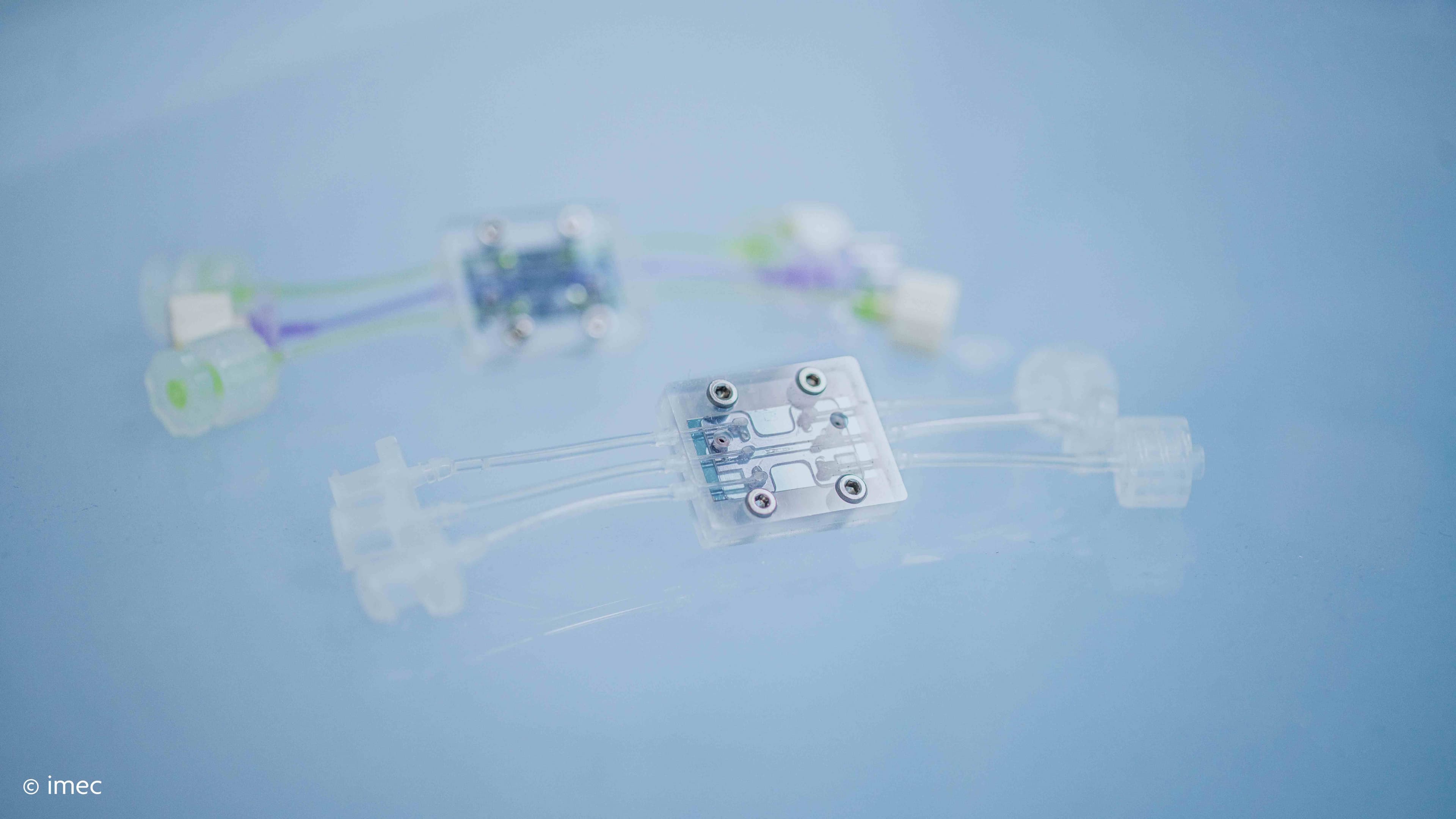
Amongst the most promising applications of imec’s deep-tech approach are their microphysiological systems (MPS) – miniaturized biological models on silicon chips that mimic human organ function. These ’organs-on-chip’ generate rich, physiologically relevant datasets that feed AI models for predictive drug design. AI is powerful, but only as good as the data it learns from. That’s why MPS are so critical: they provide richer, more predictive data than traditional cell cultures, at a fraction of the cost of animal models. They can bridge the gap between in vitro assays and expensive in vivo studies, enabling earlier, more reliable insights.
But technology alone isn’t enough. You need the biology to be close enough to real life before the data can be meaningful – and that’s where pioneers like VIB come in. Their expertise in advanced cell culture, disease modelling, and molecular biology complements imec’s strength in chip technology and computational platforms.
This synergy is especially critical in the context of neurological diseases, where access to suitable tissue is a major challenge. Human brain samples are typically only available postmortem, making them an imperfect proxy for disease modeling. The VIB-KU Leuven Center for Neuroscience’s deep knowledge of stem cell technology enables the reprogramming of cells into specific populations, such as neuronal cells, offering a more relevant and dynamic model. Ongoing projects like the Parkinson’s disease-on-chip and amyotrophic lateral sclerosis (ALS) modelling are already proving the value of such synergies between the institutes. (See 2022 papers in the Journal of Controlled Release and the EMBO journal
Tackling Parkinson’s Disease with brain-on-chip technology
Parkinson’s disease is notoriously difficult to study due to the lack of access to living brain tissue, late-stage diagnosis, and the limitations of current model systems. To overcome these barriers, Mission Lucidity unites researchers, clinicians, and engineers from imec, VIB, KU Leuven and UZ Leuven in a collaborative effort to decode Parkinson’s disease. The goal: to move beyond symptom management and toward precision treatments for neurodegenerative diseases like Parkinson’s and other neurodegenerative diseases.
The project centers on building a brain-on-chip model using patient-derived cells and advanced chip technology to recreate the neural circuits affected by disease.
- Imec has developed a high-density multi-electrode array (MEA) chip that enables precise monitoring and manipulation of neuronal circuits. With over 16,000 electrodes packed into just 1 mm2, it offers unprecedented resolution for neuronal interfacing.
- A team led by the researchers at the VIB-KU Leuven Center for Neuroscience reprograms skin cells from Parkinson’s patients – into specific neuronal cell types.
- The reprogrammed cells are used to reconstruct the specific neuronal networks most affected by Parkinson’s, grown directly on the MEA chip to measure and manipulate their electrical activity.
- Together, this approach allows to create lab-grown brain circuits on a chip that provides single-cell resolution electrical readouts in a patient-specific manner, paving the way for deeper insights into disease mechanisms, personalized biomarker discovery, stratification, and targeted therapies.
- For example, it allows researchers to ‘go back in time’ to the earliest stages of the disease, comparing the functioning of patient-derived brain cells to those from healthy individuals. It also enables the identification of molecular and functional signatures that can be used to stratify patients into subgroups.
Importantly, the brain-on-chip model enables researchers to test drug candidates directly on patient-specific neuronal networks, supporting the development of personalized treatments and connecting technological innovation to real-world clinical impact.
Find out more:
Research update: how chip technology will decipher brain diseases
Translating wet to dark labs
Looking ahead, dark labs – fully automated facilities where robotic systems, guided by AI, run experiments around the clock – could redefine drug development. These labs promise dramatic cost reductions and faster iteration cycles, making drug discovery more accessible to smaller biotech firms and academic labs. Combined with computational approaches and lab-on-chip technologies, they can democratize drug discovery.
Flanders offers a unique ecosystem for this leap: a dense network of hospitals, biotech firms, academic institutions, and global pharma players. This proximity enables rapid iteration, shared infrastructure, and early involvement of end users – clinicians, pharma, and regulators – to ensure that new technologies address real-world needs.
But proximity alone is not enough. To truly unlock the potential of digital drug discovery, we need to work together across disciplines and organizations. The challenges, building scalable microphysiological systems, creating AI-ready datasets, are too complex and costly for any single player to tackle alone.
To unlock the full potential of digital biotechnology, Europe must build a collaborative ecosystem around new technology tools and AI innovations for drug discovery. By aligning technology platforms, AI factories, and core facilities, and fostering public-private partnerships, we can dramatically shorten the time from lab to market-ready products.

Sneha is a portfolio manager in Life Sciences at imec, where she is responsible for shaping and prioritizing investments across different technology building blocks, and aligning internal R&D with external market and ecosystem needs. She operates at the interface between long term research and industrial impact, connecting deep tech research to use cases, partnerships, and pathways toward adoption.
Sneha joined imec in 2018 and has built her work around the development of sensors (for aqueous media) in the internet of things domain together with characterization and real-life validation, gaining hands‑on experience across the journey from lab to field. In her current role as a portfolio manager, she brings application‑driven perspective to technology roadmap consolidation and industry collaboration, working with pharmaceutical, biotech, and ecosystem partners to translate deep‑tech innovations into scalable, fit‑for‑purpose solutions. Her work emphasizes the integration of sensors, data, and hardware into complex biological models, including microphysiological systems, to improve translational relevance in drug discovery and development.

Saskia holds a PhD in Biotechnology from Ghent University. With a rich background spanning over a decade in fundamental Life Sciences research at Ghent University and the University of Lausanne, she embarked on a transformative journey in 2012 when she joined the endeavor to launch VIB's BioImaging Core. Initially, her primary focus revolved around the implementation of volume EM and the development of correlative light and electron microscopy workflows, catering to diverse research domains within the Life Sciences.
In 2017, she became Head of the Bioimaging Core, which enabled her to further advance the core's capabilities and services. In 2023, she became Deputy Technology Director at VIB Technologies.

Patrik Verstreken obtained his degree in bio-engineering from the university of Brussels in 1998. He joined the Graduate school of Biomedical sciences at Baylor College of Medicine and under the mentorship of Hugo Bellen he obtained a PhD in Developmental Biology in 2003. After post-doctoral training and with support of a Marie Curie Excellence grant, he became a group leader at VIB and joined the faculty of the university of Leuven (KU Leuven) in 2007. In 2017, he became Science Director at the VIB-KU Leuven Center for Neuroscience.
Patrik Verstreken has made important contributions to our understanding of synaptic function in health and neurodegenerative disease. Using fruit flies and more recently also human neurons derived from embryonic stem cells, Patrik’s work has focused on key proteins, lipids and mitochondria that regulate synaptic activity and how these molecules and organelles are misregulated in Parkinson’s disease. Patrik’s work has led to the discovery of specific presynaptic and organellar defects in Parkinson’s disease and in strategies as to how these defects can be suppressed.
Published on:
27 April 2026