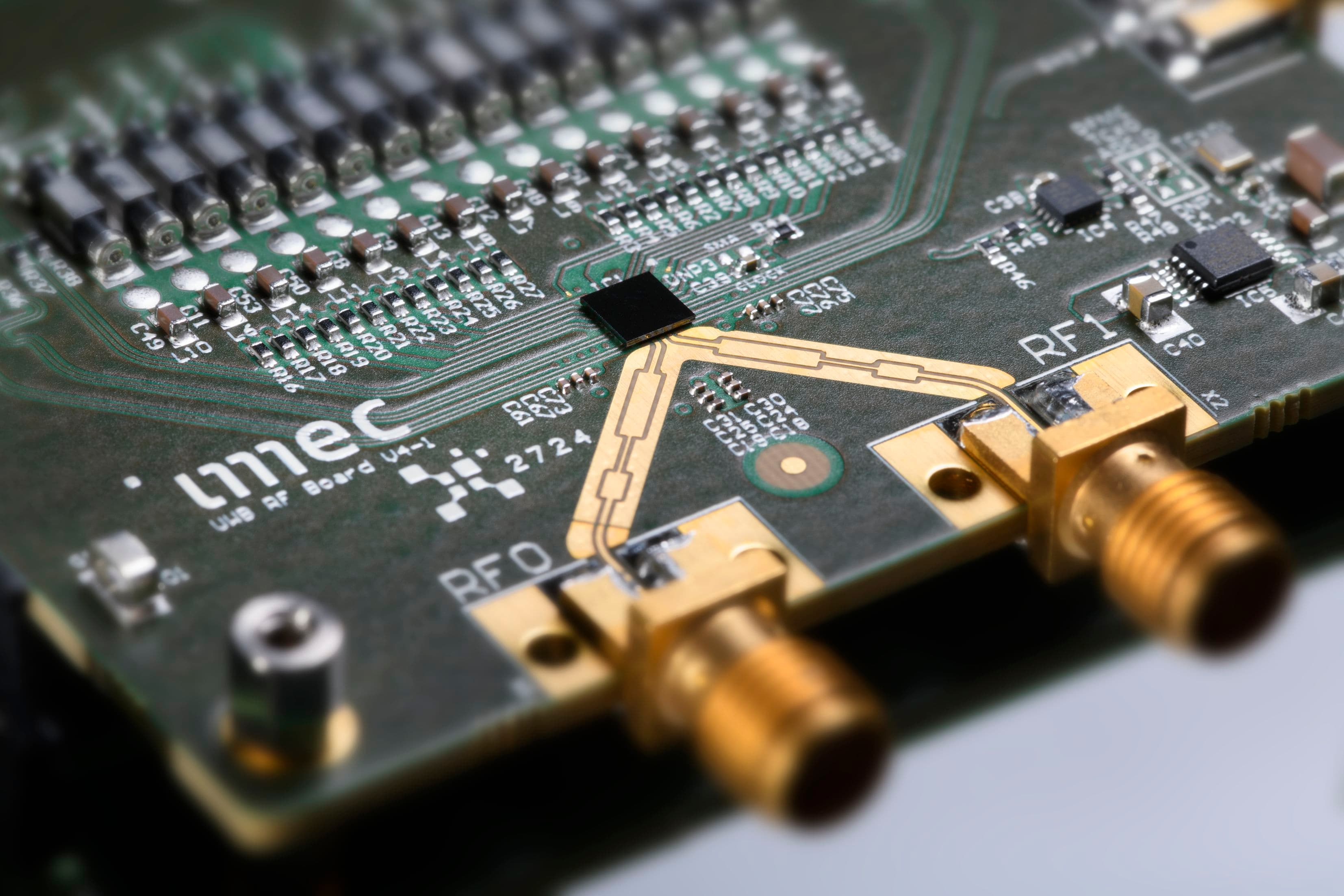
Ultra-wideband (UWB) technology
Use imec’s high-precision and low-power wireless technology to design and manufacture your next-generation UWB chips.
Ultra‑wideband (UWB) is a wireless technology that uses very low‑power signals spread across a wide range of frequencies.
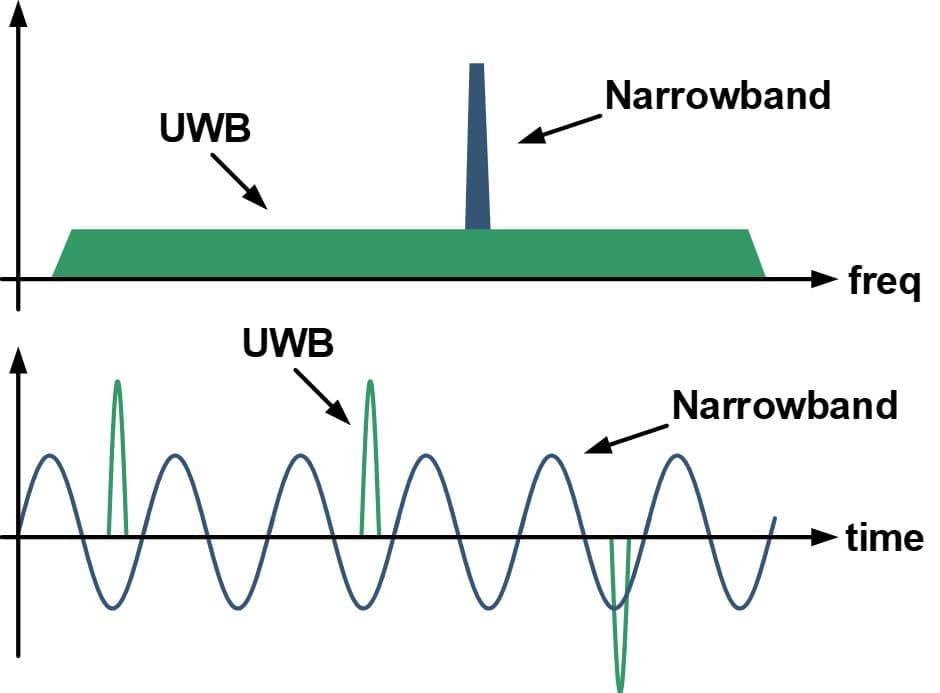
A key feature of UWB communication is its use of extremely short bursts of radio energy. In impulse‑radio (IR) UWB systems, these bursts are pushed to nanosecond‑ or even picosecond‑scale.
Because such brief pulses spread their energy across a very broad frequency range, UWB occupies far more spectrum than conventional narrowband technologies like Wi‑Fi or Bluetooth.
Imec has a track record of more than fifteen years in UWB technology, developing hardware and software UWB transceiver IP. We participate in various UWB standardization bodies and industry consortia, such as the, IEEE, CCC, ETSI and FCC. And we're a member of the FiRa consortium – dedicated to the development and adoption of user experiences using interoperable UWB technologies.
Ultra-wideband applications
UWB technology supports a broadening set of applications. Its commercial use for accurate positioning is already well established. Lately, its large bandwidth and pulse‑based operation are opening the door to novel communication and radar capabilities.
Low‑power wireless: a crucial link between AI and the physical world
UWB location tracking
In many IoT applications, it’s crucial that devices are spatially aware. We need to know their position and movement – in a two- or three-dimensional space.
Several technologies are available for positioning. But none beats ultra-wideband (UWB) when it comes to:
- speed and update rates
- accuracy and precision
- security against relay attacks
Today, UWB provides cm- to mm-level location information between a transmitter (TX) and receiver (RX) that are 10-15 meters apart. It’s an ideal match with advanced applications such as:
- secure access and secure keyless entry
- high-precision distance measurement
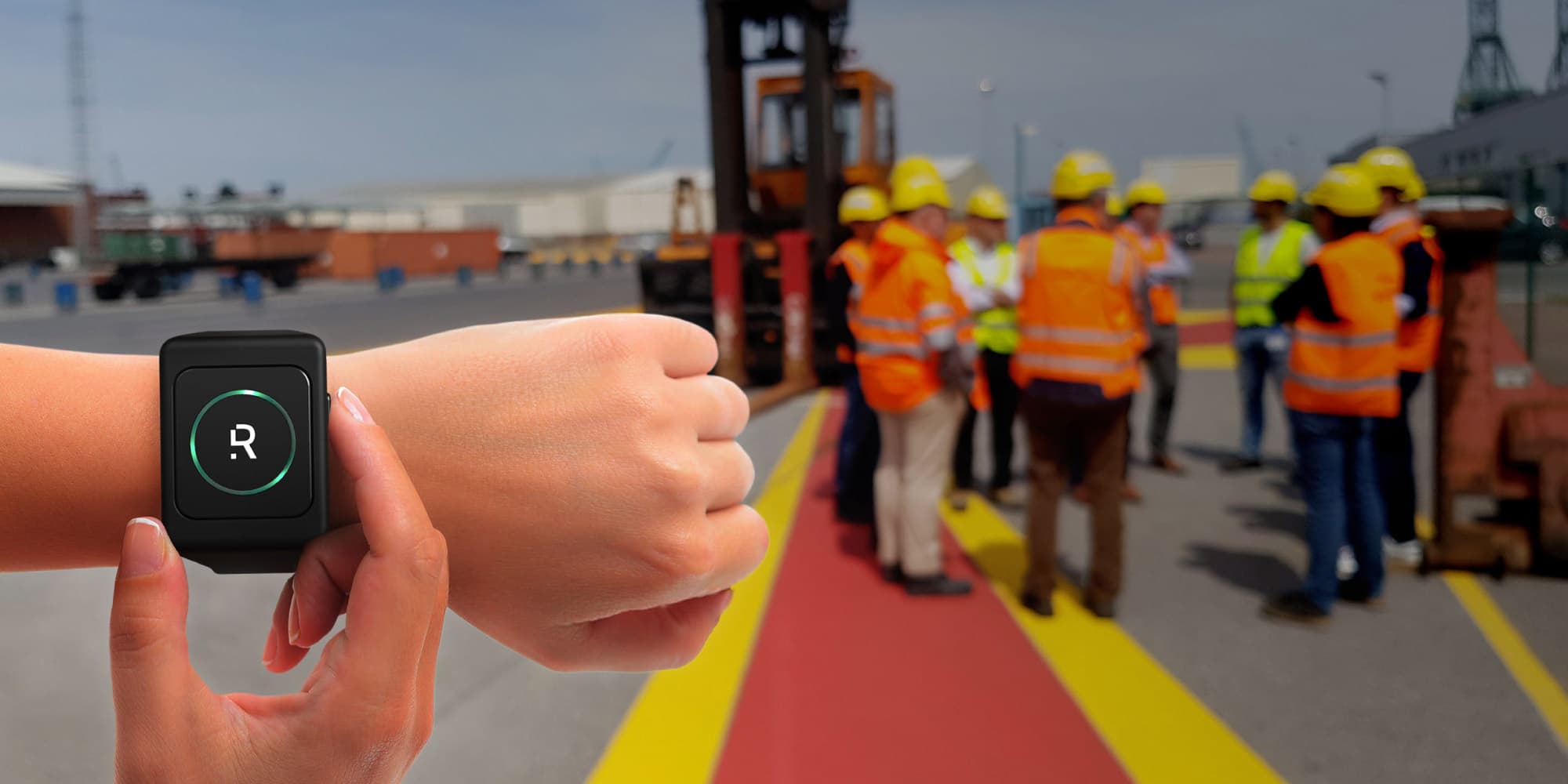
- indoor positioning and tracking
- VR/AR
- secure mobile payments
In the near future, narrowband-assisted UWB operation will enable advanced ranging, extending the distance up to 100 m when there’s free line of sight and significantly improving the user experience.
UWB communication
Imec’s latest IR-UWB transceiver provides a record-high data rate of 124.8Mb/s –approximately 20 times higher than the data rate currently in use in ranging and communication applications.
This high data rate is paired with low latency and low energy per bit. This makes ultra-wideband wireless communication a strong contender for applications that require high-rate data transfer at short distances with very low energy consumption, such as smart glasses for AR/VR, and neuroscientific research.
UWB radar
UWB is increasingly being explored as a compact radar technology. Instead of relying on two devices to measure distance, UWB radar uses a single unit that sends ultra‑short pulses and interprets the reflected signals to detect objects or movements.
UWB radar enables a range of new applications. In automotive, it can support functions such as detecting in‑cabin detection or monitoring subtle motions like breathing or gestures to enhance occupant safety.
In homes and buildings, UWB radar sensors can enable adaptive lighting or automation based on where people are. And in care environments, they offer a way to detect falls or unusual inactivity, in a more privacy-friendly manner than by using cameras.
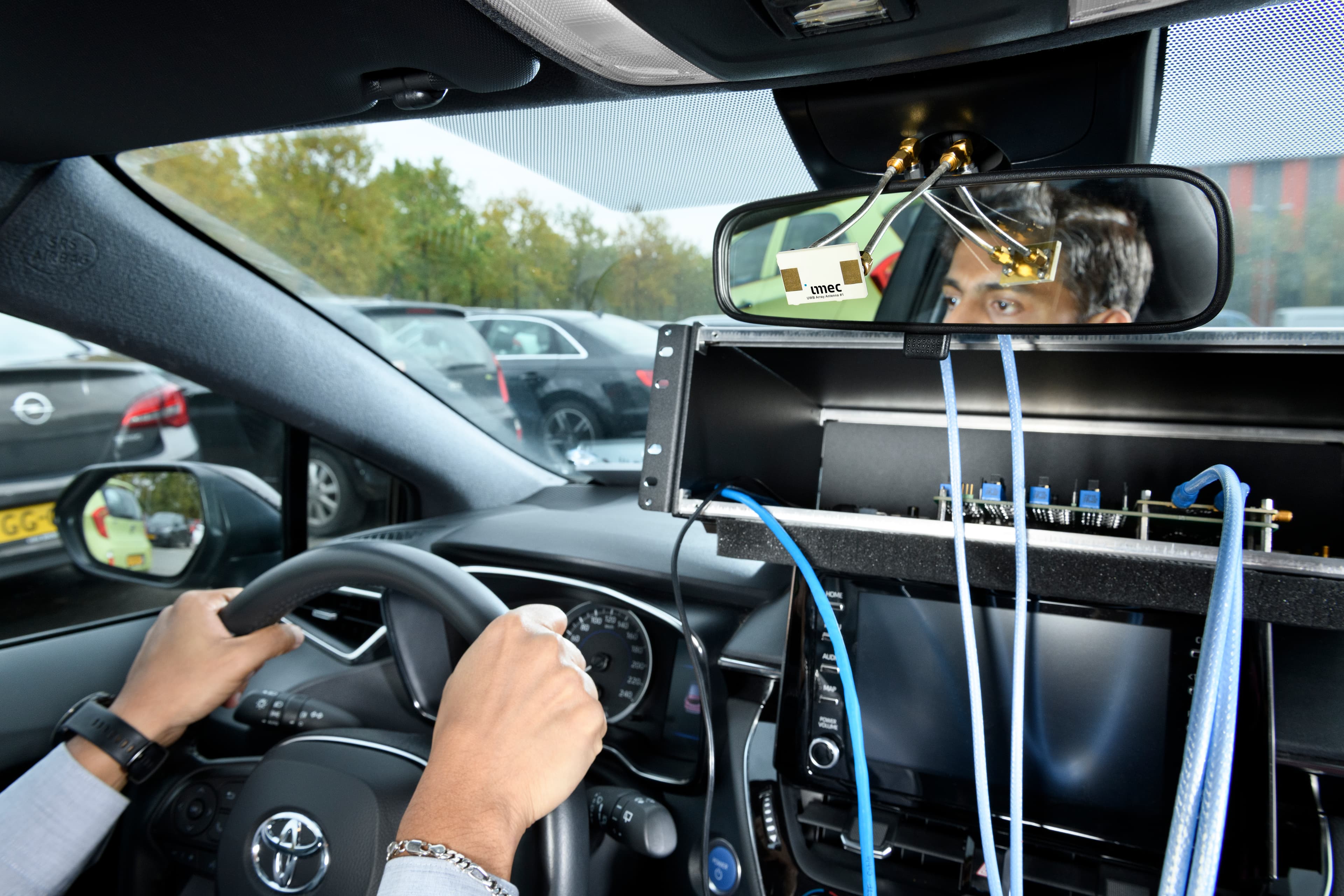
Proof-of-concept of imec’s latest UWB radar system performing in-cabin sensing: occupancy detection and breathing rate estimation.
Next-generation ultra-wideband technology
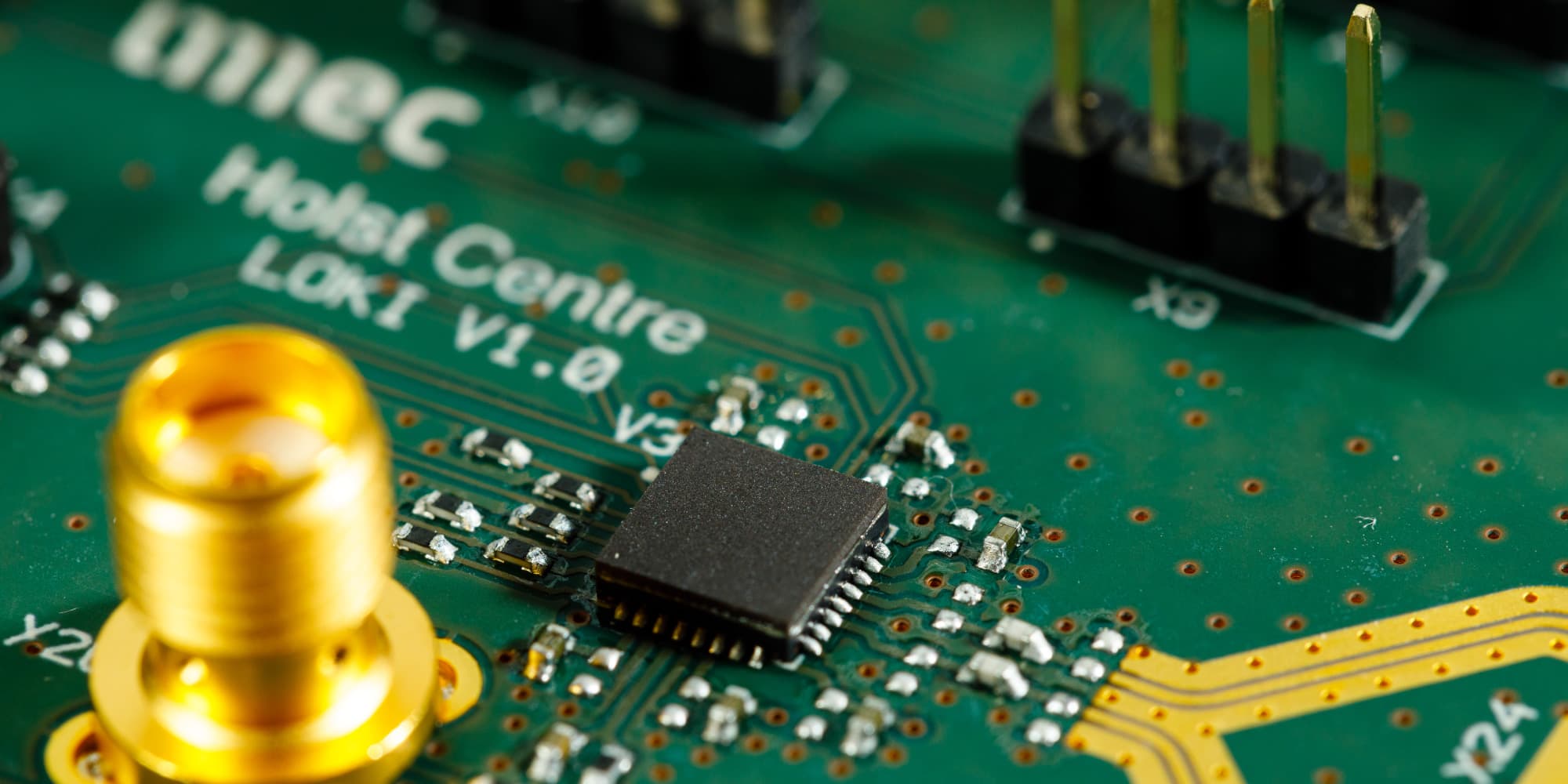
Imec builds its ultra-wideband technology on a standard CMOS platform. This results in UWB chips that can be cost-effectively mass-produced, and easily integrated with other chip components.
Additionally, our UWB impulse radio (IR) technology excels because of its limited power consumption – ten times lower than the state of the art. Enabled by advanced polar transmitter, digital phase-locked loop (PLL), and ring oscillator-based architectures, imec’s transmitter circuits operate through innovative pulse shape and modulation techniques that attain mm-scale ranging precision.
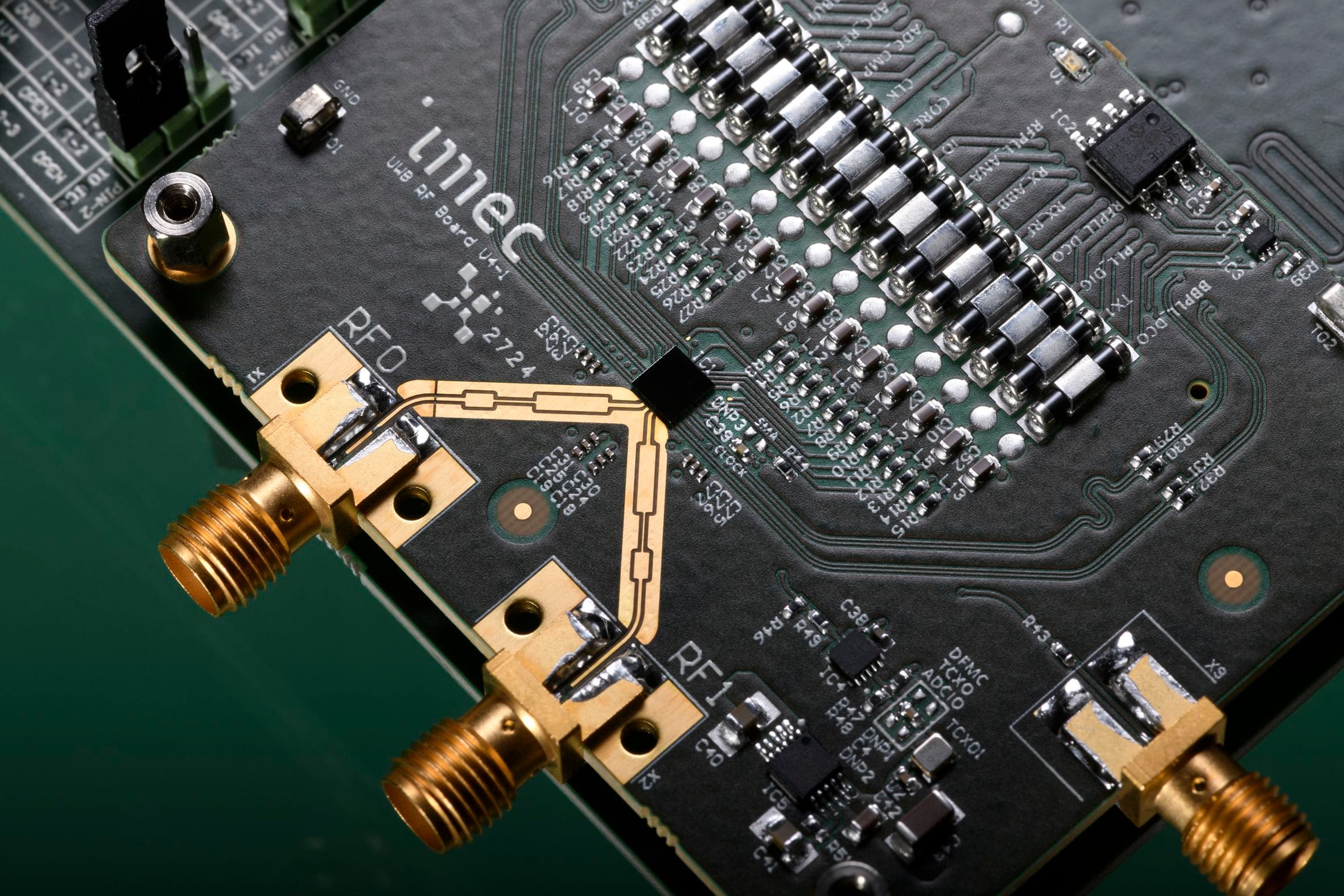
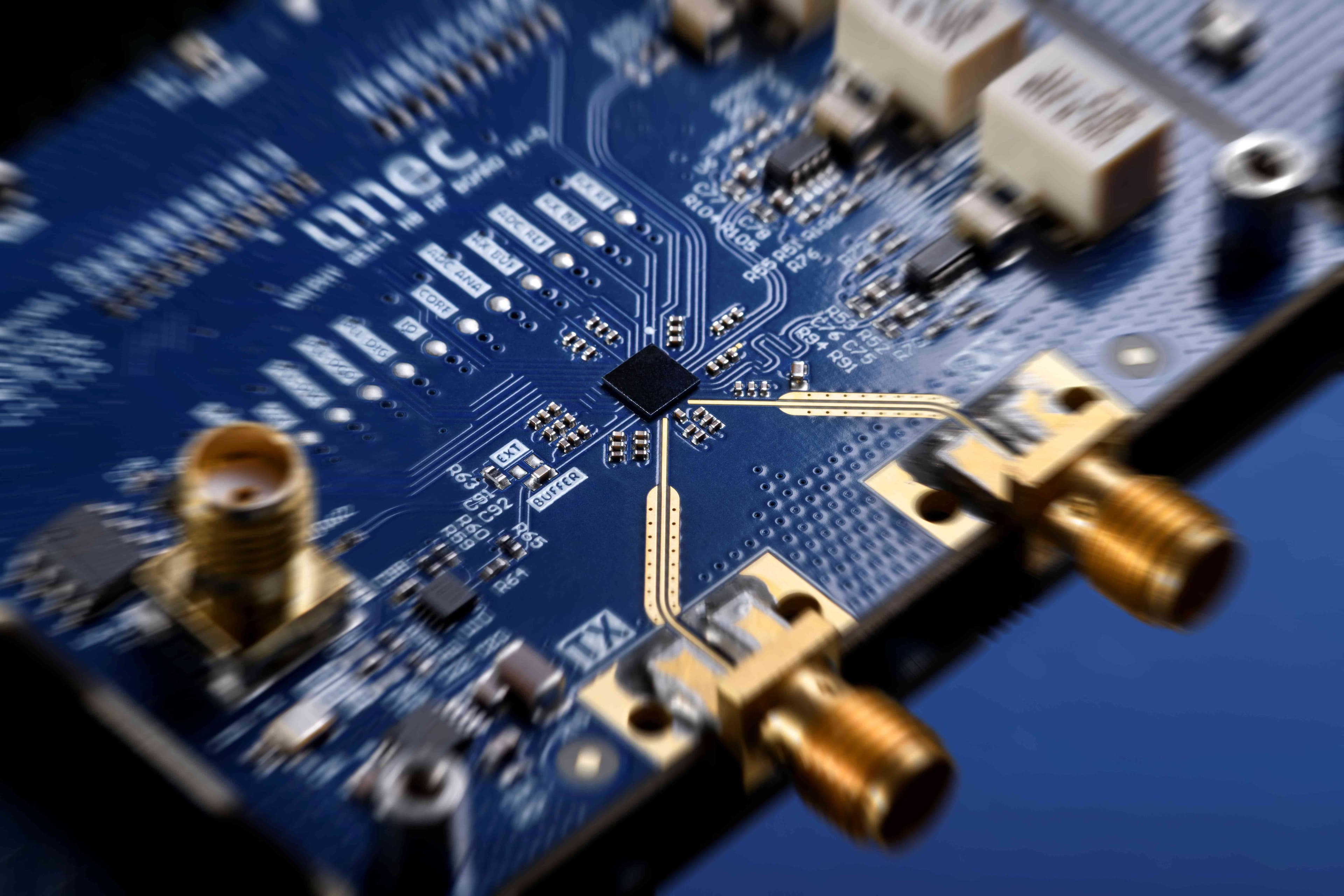
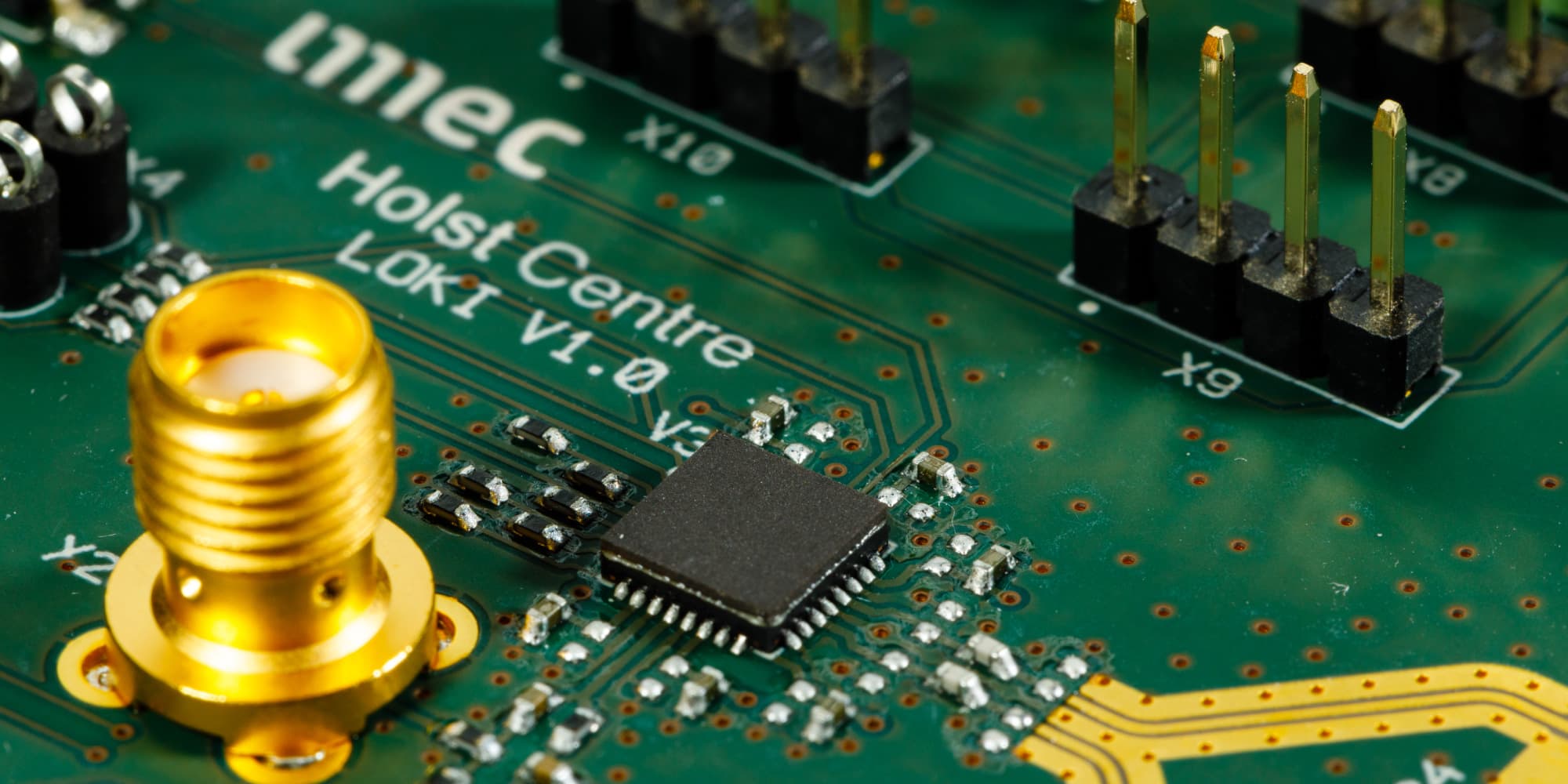
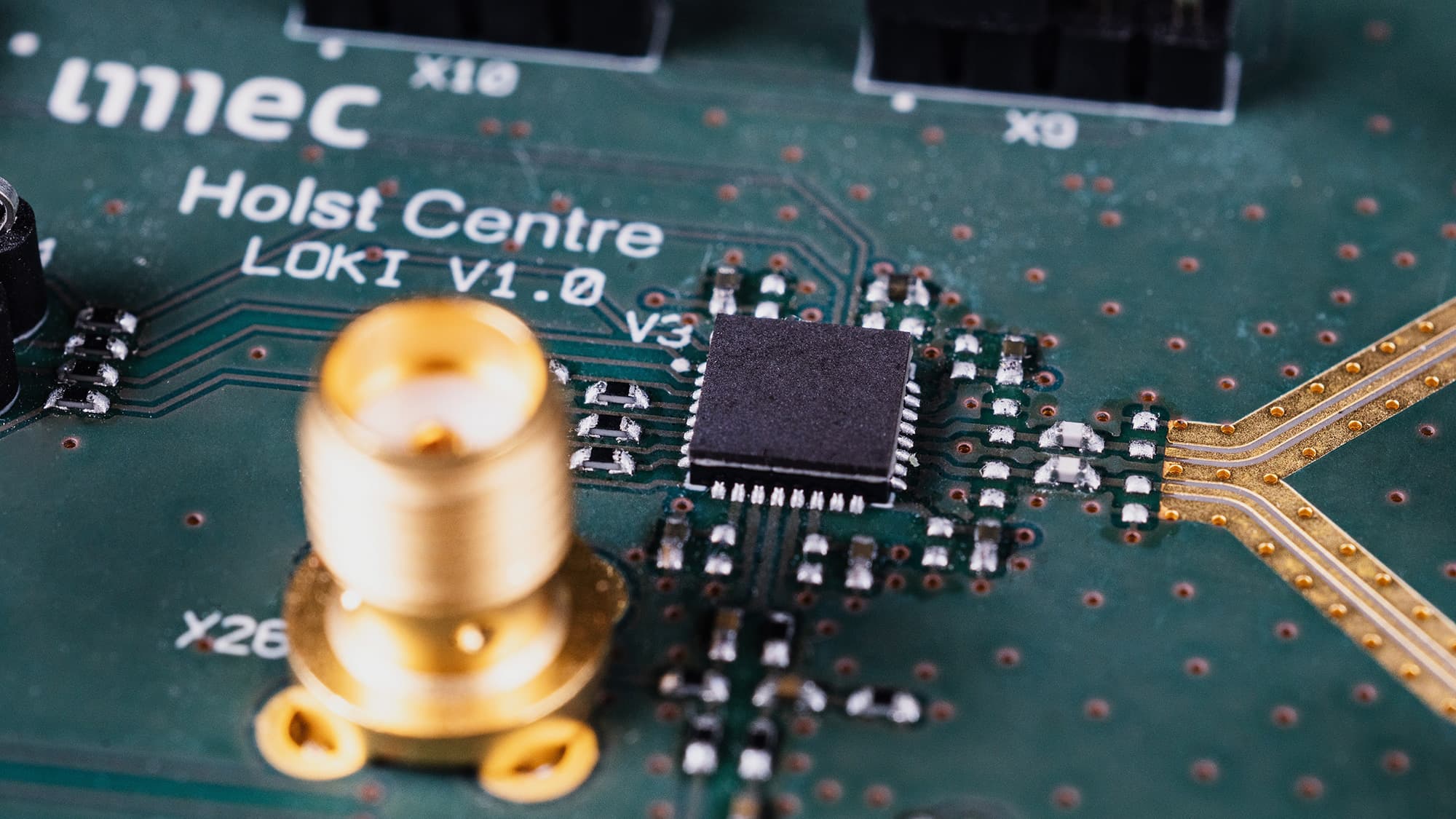
Imec’s Gen-4 IR-UWB radio system.
Use imec’s expertise for your UWB solution
Do you want to speed up the integration of advanced ultra-wideband technology in your product or service? We offer a wide range of hardware and software IP, such as:
- UWB positioning and tracking algorithms that achieve cm- to mm-accuracy in challenging environments
- secure distance bounding protocols for the prevention of relay attacks
- analog and digital IC designs, layout databases and test benches of wireless transceivers and building blocks
- proof-of-concept integrated circuit implementations and demonstrators
- antenna designs
Imec is happy to support you in three ways:
- design on demand – Rely on our top researchers and advanced infrastructure for your custom R&D into ultra-wideband technology.
- insight partnership – Get previews of our latest developments via regular concept and prototype demonstrations.
- whitebox silicon IP licensing and technology transfer – Tune our hardware and software IP to your needs, with support from our experts.
Thanks to IC-Link, imec’s division for chip manufacturing, we can support you all the way from idea to product.
Imec not only helps you to address technological challenges. Thanks to our thorough knowledge of the sectors such as automotive, we function as your full-fledged strategic partner – right down to venturing support.
Click the button below to get in touch.