
NG-UWB
Next-Generation Ultra-WideBand localization and activity monitoring
A new generation of affordable UWB localization and activity tracking
Ultra-wideband (UWB) is a radio technology that transmits information over a very wide bandwidth, typically more than 500 MHz. By emitting extremely short pulses of less than 2 nanoseconds, UWB-enabled devices can measure the travel time of signals with far greater precision than conventional technologies such as Wi-Fi or Bluetooth. This enables highly accurate distance estimation, making UWB well suited for localization with errors below 20 cm.
Since the introduction of affordable UWB radio chips around 2013, numerous Flemish companies have developed UWB-based solutions, highlighting both the strong regional expertise and the strategic importance of this technology in Flanders.
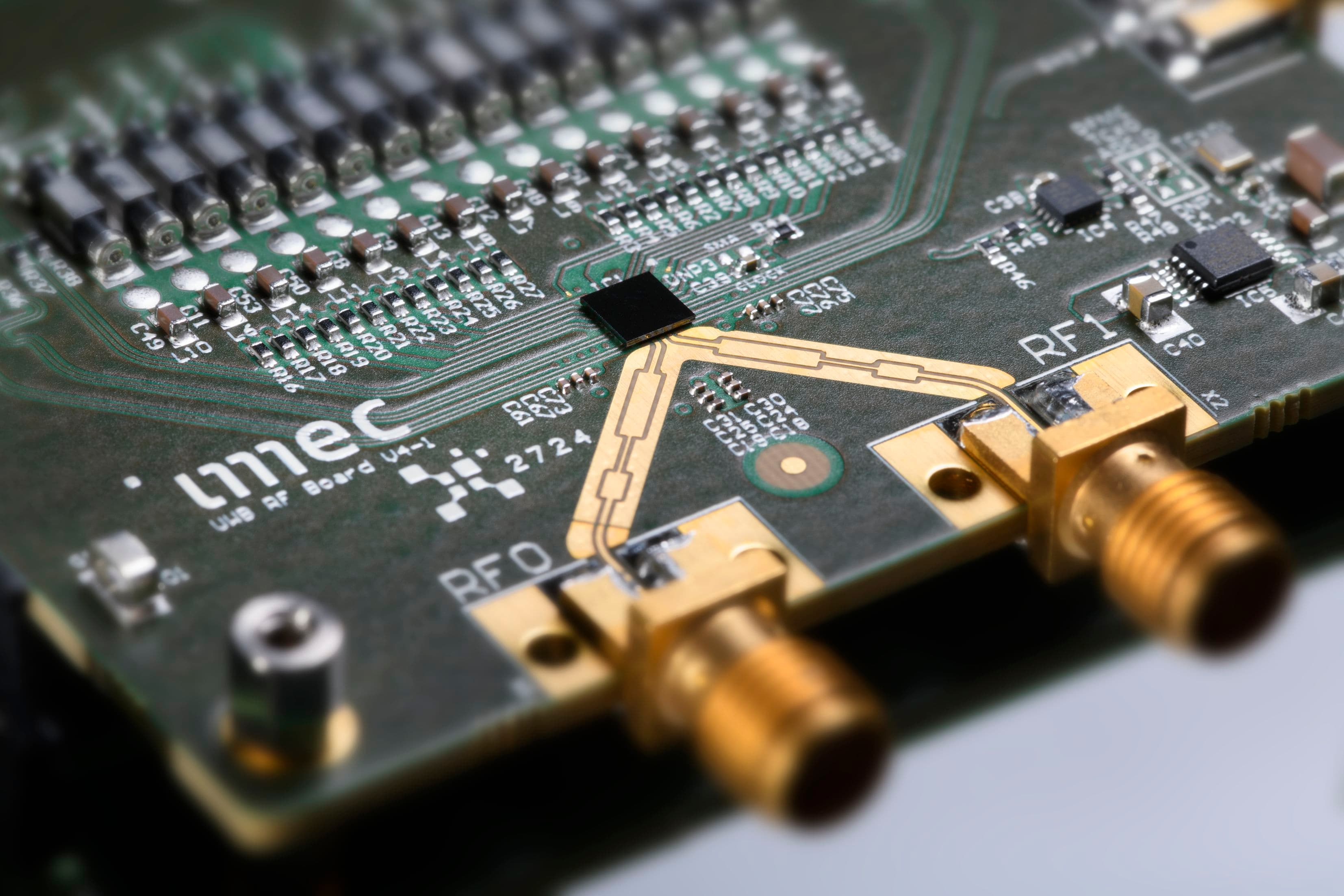
A new generation of UWB chips, supporting multiple antennas, is now being integrated into consumer devices such as smartphones. For the Flemish industry, these multi-antenna systems represent a major step forward, improving the commercial viability of real-time location systems (RTLS) while enabling novel radar-based sensing applications with minimal infrastructure requirements.
The NG-UWB project aims to unlock these opportunities by combining innovations in hardware design and signal processing.
Innovation in localization and radar applications
The multi-antenna approach developed in NG-UWB will enable real-time localization using only a single anchor per room, in contrast to the multiple anchors typically required today. This is achieved by jointly exploiting phase and timing information across multiply antennas, combined with artificial intelligence (AI) techniques to estimate both distance and angles simultaneously.
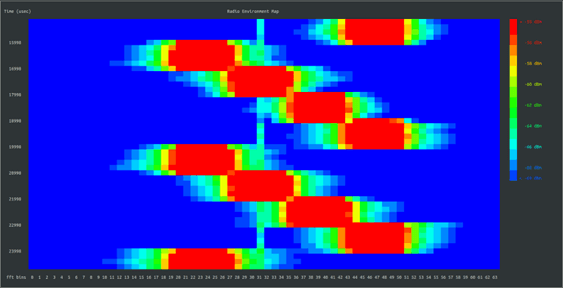
In addition, multi-antenna UWB radios do not only transmit signals, but can also receive their reflections across the antenna array, enabling radar functionality. By analyzing the time delay and frequency shift between the pulse transmission and the received reflection, these systems can detect presence and motion. NG-UWB leverages this capability for advanced sensing applications, including presence detection, activity recognition, vital sign monitoring, gesture recognition, and warehouse and transport applications.
Compared to existing solutions, these hardware and software innovations reduce installation complexity, as well as maintenance and operational costs. Next-generation UWB systems will offer higher throughput, improved robustness, lower energy consumption and more accurate ranging.
These capabilities will support advanced localization and sensing solutions across multiple domains. In healthcare and assisted living, they enable unobtrusive monitoring of changes in daily activity patterns. In public transport they can be used for applications such as seat occupancy detection. In industrial settings such as warehouses and manufacturing, NG-UWB enables accurate asset tracking, worker safety monitoring, and workflow optimization with minimal infrastructure.
Demonstrating the power of next-generation UWB
The NG-UWB project partners will develop two demonstrators to validate and showcase the technology in realistic environments, supporting their respective valorization strategies.
- The first demonstrator will focus on industrial use cases, estimating the location of five tags within a 5 × 5 meter warehouse environment with obstacles. The system will achieve an accuracy of 30 cm while operating with only a single anchor node.
- The second demonstrator will focus on distinguishing between five activities of a single person (standing, sleeping, sitting, walking, falling), while also estimating the person’s location in a 5 x 5 meter living room with obstacles, using a single anchor node.
“NG-UWB advances ultra-wideband technology by enabling single-anchor localization and supporting multi-person activity monitoring. Through improved antenna design and embedded AI, it significantly reduces infrastructure requirements and associated costs. From healthcare to logistics, it delivers scalable, privacy-preserving solutions and reinforces Flanders’ position as a leader in UWB innovation.”
NG-UWB
NG-UWB aims to design UWB hardware and signal processing pipelines to allow single-anchor node localization and activity tracking.
NG-UWB is an imec.icon research project funded by imec and Agentschap Innoveren & Ondernemen (VLAIO).
The project started on 01.10.2025 and is set to run until 30.09.2028.
Project information
Industry
- Connect Group
- Dekimo Gent
- Pozyx
- Televic Healthcare
- Televic Rail
- Qorvo Belgium
Research
- imec – IDLab IBCN – UGent
- imec – WAVES – UGent
Contact
- Project lead: Jeroen Van Hecke, Pozyx
- Research lead: Eli De Poorter, imec – IDLab IBCN – UGent
- Proposal manager: Jaron Fontaine, imec – IDLab IBCN – UGent
- Innovation manager: Deben Lamon